Hey there! As a supplier of ribbon blenders and paddle blenders, I often get asked about the operating costs of these machines. So, I thought I’d break it down for you in this blog post. Ribbon Blender And Paddle Blender

Understanding the Basics
First off, let’s quickly go over what ribbon blenders and paddle blenders are. A ribbon blender is a type of industrial mixer that uses a set of inner and outer helical ribbons to move materials in a figure-eight pattern. This design ensures thorough mixing of dry powders, granules, and even some viscous liquids. On the other hand, a paddle blender has a series of paddles attached to a rotating shaft. These paddles agitate the materials, providing a gentle yet effective mixing action, which is great for fragile or heat – sensitive products.
Operating Cost Components
Energy Consumption
One of the biggest factors in the operating cost of both ribbon and paddle blenders is energy consumption. Ribbon blenders typically have a higher power requirement because of the larger motor needed to drive the ribbons. The ribbons have to move a large volume of material, and they need a fair amount of torque to do so.
For example, a medium – sized ribbon blender might have a motor rated at 10 – 15 horsepower. If you run this blender for 8 hours a day, 5 days a week, the energy cost can add up. Let’s say the cost of electricity is $0.15 per kilowatt – hour. A 10 – horsepower motor (which is approximately 7.46 kilowatts) running for 8 hours a day will consume 7.46 x 8 = 59.68 kilowatt – hours per day. Over a 5 – day week, that’s 59.68 x 5 = 298.4 kilowatt – hours, and the cost will be 298.4 x $0.15 = $44.76 per week.
Paddle blenders, on the other hand, usually have a lower power requirement. A similar – sized paddle blender might have a 5 – 10 horsepower motor. Using the same electricity cost and running time, a 5 – horsepower motor (about 3.73 kilowatts) will consume 3.73 x 8 = 29.84 kilowatt – hours per day. Over a 5 – day week, it’s 29.84 x 5 = 149.2 kilowatt – hours, and the cost is 149.2 x $0.15 = $22.38 per week. So, in terms of energy, paddle blenders are generally more cost – effective.
Maintenance and Repairs
Maintenance is another significant part of the operating cost. Ribbon blenders have more moving parts, specifically the ribbons. These ribbons are in constant contact with the materials being mixed, and they can wear out over time. Replacing the ribbons can be expensive, especially if they are made of high – quality materials. You also need to regularly check the bearings and the drive system to ensure smooth operation.
Paddle blenders have fewer complex parts. The paddles are relatively simple and less likely to break compared to the ribbons in a ribbon blender. However, the bearings and the motor still need to be maintained. The cost of maintenance for a paddle blender is generally lower than that of a ribbon blender. But keep in mind that if a paddle breaks, it can cause uneven mixing, and you’ll need to replace it promptly.
Material Costs
The materials used in the blenders also contribute to the operating cost. For both ribbon and paddle blenders, the construction materials matter. If you opt for a blender made of stainless steel, it will be more expensive upfront but will last longer and be more resistant to corrosion. This means less frequent replacement of the blender due to rust or other damage.
When it comes to the materials being mixed, ribbon blenders are better at handling abrasive materials. But if you’re mixing very fine powders, there might be some material loss due to the high – speed movement of the ribbons. Paddle blenders are more gentle, so there’s less risk of material loss, especially for fragile materials.
Comparing Operating Costs in Different Applications
Food Industry
In the food industry, cleanliness and gentle mixing are crucial. Paddle blenders are often preferred because they can handle ingredients like flour, sugar, and spices without damaging them. The lower energy consumption and maintenance cost make them a cost – effective choice for small to medium – sized food processing plants.
Ribbon blenders can also be used in the food industry, especially for larger – scale production. However, the higher energy cost and the potential for material loss need to be considered. If you’re mixing large volumes of dry ingredients, the benefits of a thorough mix from a ribbon blender might outweigh the extra costs.
Chemical Industry
The chemical industry requires precise mixing of different substances. Ribbon blenders are commonly used here because they can handle a wide range of viscosities. They can mix chemicals that are dry, wet, or even pasty. But the high energy consumption of ribbon blenders can be a concern, especially for energy – intensive chemical processes.
Paddle blenders are used for more delicate chemical mixtures, such as those containing heat – sensitive compounds. The gentle mixing action of paddle blenders helps prevent chemical reactions that could be triggered by excessive agitation. The lower operating cost of paddle blenders is an added advantage in this industry.
Reducing Operating Costs
Regular Maintenance
No matter which type of blender you choose, regular maintenance is key to reducing operating costs. For ribbon blenders, this means checking the ribbons for wear and tear, lubricating the bearings, and ensuring the motor is running efficiently. For paddle blenders, you should inspect the paddles, clean the blender regularly, and also maintain the motor.
Energy – Efficient Motors
Investing in energy – efficient motors can significantly reduce the energy cost. There are motors available in the market that are designed to use less electricity while still providing the required power. This is especially important for ribbon blenders, which have a higher power consumption.
Right Sizing
Choosing the right size of blender for your production needs is crucial. If you have a small – scale operation, a large blender will be a waste of energy and money. On the other hand, if you have a large – scale production and use a small blender, you’ll need to run it for longer periods, increasing the energy cost.
Conclusion
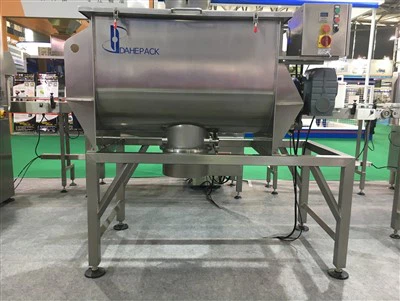
So, to sum it up, the operating cost of a ribbon blender and a paddle blender depends on several factors. Ribbon blenders generally have higher energy consumption and maintenance costs but are great for large – scale mixing and abrasive materials. Paddle blenders are more energy – efficient, have lower maintenance costs, and are suitable for gentle mixing of fragile or heat – sensitive materials.
Bag Filling Machine If you’re in the market for a ribbon blender or a paddle blender, and you want to discuss the best option for your specific needs and budget, feel free to reach out. I’d be more than happy to help you find the right blender and give you a detailed cost analysis. Let’s work together to make your production process more cost – effective and efficient.
References
- Perry, R. H., & Green, D. W. (1997). Perry’s Chemical Engineers’ Handbook. McGraw – Hill.
- Brown, R. C. (1992). Unit Operations in Food Processing. Elsevier Applied Science.
Shanghai Dahe Packaging Machinery Co., Ltd.
Shanghai Dahe Packaging Machinery Co., Ltd. is one of the most professional ribbon blender and paddle blender manufacturers and suppliers in China, featured by quality products and competitive price. Please rest assured to buy high-grade ribbon blender and paddle blender for sale here from our factory.
Address: 1098#, Minta Road, Songjiang District, Shanghai, 201617, China.
E-mail: International@dahepack.com
WebSite: https://www.dahe-powderfillingmachines.com/
